





Agnes-3.0-Flash Preview
Model version clarification
This repository contains an earlier open-weight Preview checkpoint of Agnes 3.0 Flash. It is distinct from the newer production/API checkpoint listed on Artificial Analysis.
The Preview release has 33B parameters and a context window of 262,144 tokens. The production/API model uses a different checkpoint and configuration, with a 1M-token context window. Its benchmark results should not be attributed to the Preview weights released here.
This repository was initially published as Agnes-3.0-Flash without the Preview suffix. The model card now explicitly identifies this release as Agnes-3.0-Flash Preview to clarify the distinction between the open-weight release and the production/API model.
The specifications and Agnes benchmark results below refer to the Preview checkpoint.
Hello! 👋 Today we are introducing Agnes-3.0-Flash Preview, an open-weights multimodal preview model built for people who want flagship-class reasoning without flagship-class hardware.
Highlights:
- Competitive across core capabilities. Agnes-3.0-Flash Preview posts competitive results across reasoning, coding, and instruction-following evaluations.
- Built for demanding work. A 262 144-token context window, adjustable reasoning effort, tool calling, and text, image and video understanding.
Benchmarks
Benchmark scope: The Agnes results in the chart and table below belong to the Agnes-3.0-Flash Preview open-weight checkpoint released in this repository. They are not results for the production/API Agnes 3.0 Flash model listed on Artificial Analysis.
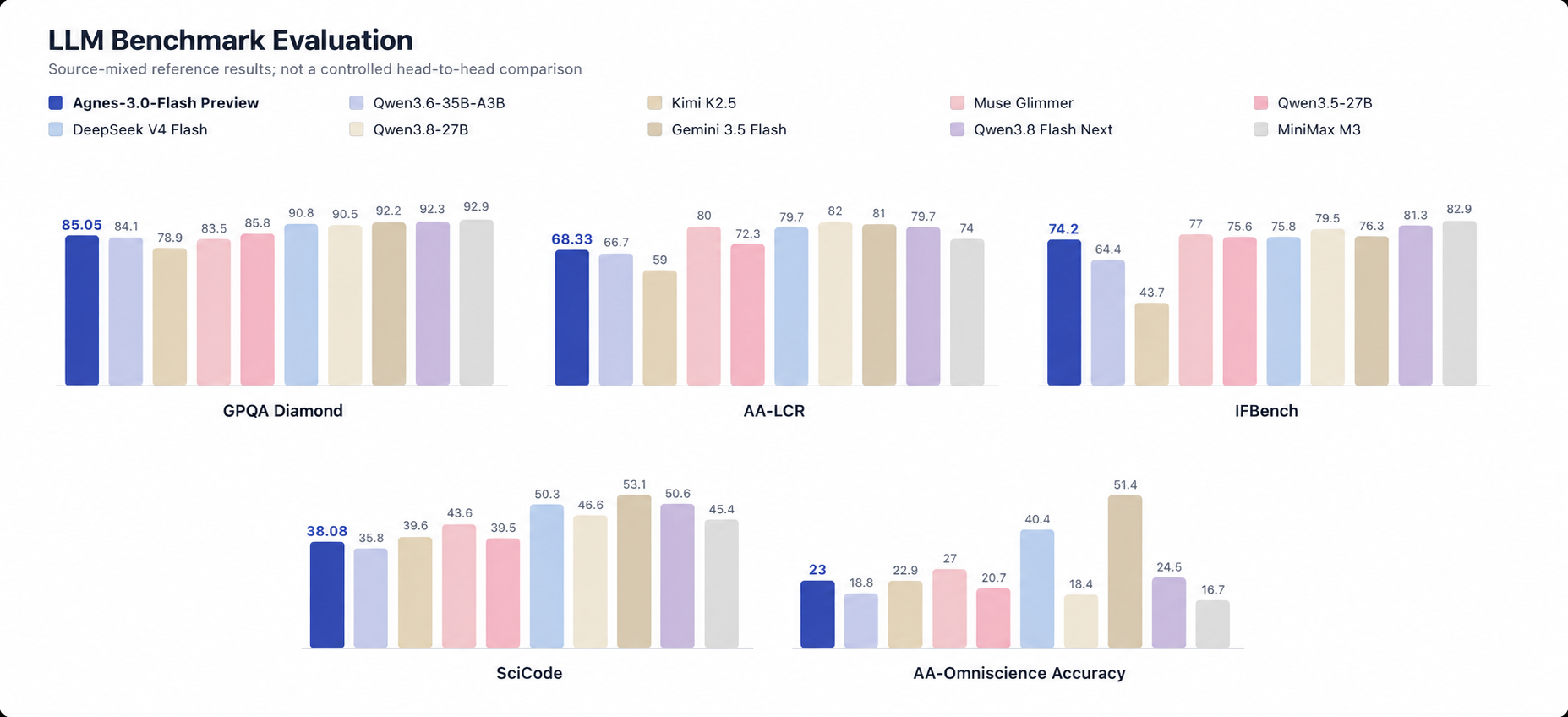
The Agnes-3.0-Flash Preview scores in the chart correspond to the open-weight checkpoint released in this repository. Reference results across contemporary models are shown below. The figures were compiled from different sources, harnesses, and model snapshots and do not constitute a controlled head-to-head comparison.
| Benchmark | Agnes-3.0-Flash Preview | Qwen3.6-35B-A3B 35B / 3B active |
Kimi K2.5 1T / 32B active |
Muse Glimmer 30B |
Qwen3.5 27B |
DeepSeek V4 Flash 0731 284B / 13B active |
Qwen3.8 27B |
Gemini 3.5 Flash undisclosed |
Qwen3.8 Flash Next 125B / 6B active |
MiniMax M3 428B / 23B active |
|---|---|---|---|---|---|---|---|---|---|---|
| IFBench | 74.20 | 64.4 | 43.7 | 77.0 | 75.6 | 75.8 | 79.5 | 76.3 | 81.3 | 82.9 |
| SciCode | 38.08 | 35.8 | 39.6 | 43.6 | 39.5 | 50.3 | 46.6 | 53.1 | 50.6 | 45.4 |
| GPQA Diamond | 85.05 | 84.1 | 78.9 | 83.5 | 85.8 | 90.8 | 90.5 | 92.2 | 92.3 | 92.9 |
| AA-LCR | 68.33 | 66.7 | 59.0 | 80.0 | 72.3 | 79.7 | 82.0 | 81.0 | 79.7 | 74.0 |
| AA-Omniscience Accuracy | 23.00 | 18.8 | 22.9 | 27.0 | 20.7 | 40.4 | 18.4 | 51.4 | 24.5 | 16.7 |
Higher is better for every row. Header parameter figures mix total and active counts, and harnesses and snapshot dates differ across sources, so treat cross-column comparisons as reference values rather than a controlled head-to-head evaluation.
Architecture
Agnes-3.0-Flash Preview is a hybrid-attention decoder: three of every four layers run a gated delta rule (recurrent, with per-layer state independent of sequence length), and the fourth runs standard global attention. Only 18 of the 72 layers therefore hold a KV cache that grows with context.
| Context length | 262 144 tokens |
| Decoder layers | 72 = 54 delta-rule recurrent + 18 global attention, alternating 3 : 1 |
| Hidden size | 5120 |
| Global attention | 24 query heads / 4 KV heads (6 : 1 GQA), head dim 256; RMS-norm on q and k, sigmoid-gated output |
| Delta-rule layers | 16 key heads / 48 value heads, head dim 128; causal conv (kernel 4) in front, gated RMS-norm; recurrent state in fp32 |
| Feed-forward | SwiGLU, intermediate size 17408; plus a parallel SwiGLU 2048 branch in every layer |
| Positions | 3-axis rotary (text / height / width), interleaved mrope sections 11 : 11 : 10, base 1e7, applied to the first 25 % of each head dim (64 dims) |
| Vocabulary | 248 320 |
| Vision tower | 27 layers, hidden 1152, patch 16, 2 × 2 spatial merge, projected to 5120 |
Quickstart
Agnes-3.0-Flash Preview ships its own model implementation. Always load it with trust_remote_code=True.
Requirements
pip install "transformers>=5.12" torch torchvision accelerate
Tested on transformers 5.12.1. Image and video inputs go through the bundled processor, which needs torchvision.
Transformers
from transformers import AutoModelForCausalLM, AutoTokenizer
path = "Agnes-AI/Agnes-3.0-Flash"
tok = AutoTokenizer.from_pretrained(path)
model = AutoModelForCausalLM.from_pretrained(
    path, dtype="bfloat16", device_map="auto", trust_remote_code=True
)
msgs = [{"role": "user", "content": "请用三句话解释什么是人工智能。"}]
ids = tok.apply_chat_template(msgs, add_generation_prompt=True, return_tensors="pt").to(model.device)
out = model.generate(ids, max_new_tokens=256)
print(tok.decode(out[0][ids.shape[1]:], skip_special_tokens=True))
Images and video
Image and video inputs go through the bundled processor (also remote code):
from transformers import AutoProcessor
proc = AutoProcessor.from_pretrained(path, trust_remote_code=True)
msgs = [{"role": "user", "content": [{"type": "image", "image": "photo.jpg"},
                                     {"type": "text", "text": "描述这张图。"}]}]
inputs = proc.apply_chat_template(msgs, add_generation_prompt=True, tokenize=True,
                                  return_dict=True, return_tensors="pt").to(model.device)
out = model.generate(**inputs, max_new_tokens=256)
print(proc.batch_decode(out[:, inputs["input_ids"].shape[1]:], skip_special_tokens=True)[0])
Reasoning effort
The chat template exposes three reasoning levels — high (default), medium, low — plus a thinking-off switch:
ids = tok.apply_chat_template(msgs, add_generation_prompt=True, return_tensors="pt",
                              reasoning_effort="medium")   # or enable_thinking=False
Tool calling
The chat template renders tool definitions for you. The model emits calls as <tool_call><function=…><parameter=…>, and you feed results back as a tool role message:
tools = [{
    "type": "function",
    "function": {
        "name": "get_weather",
        "description": "Look up current weather for a city",
        "parameters": {
            "type": "object",
            "properties": {"city": {"type": "string", "description": "City name"}},
            "required": ["city"],
        },
    },
}]
msgs = [{"role": "user", "content": "What's the weather in Beijing right now?"}]
ids = tok.apply_chat_template(msgs, tools=tools, add_generation_prompt=True,
                              return_tensors="pt").to(model.device)
out = model.generate(ids, max_new_tokens=256)
reply = tok.decode(out[0][ids.shape[1]:], skip_special_tokens=True)

# <tool_call>

# <function=get_weather>

# <parameter=city>

# Beijing

# </parameter>

# </function>

# </tool_call>

# run the tool, append the result, generate the final answer
msgs += [{"role": "assistant", "content": reply},
         {"role": "tool", "content": "Clear, 26°C, light northeasterly wind"}]
Over the OpenAI API pass tools= the same way. The server returns the text above verbatim by default; to get structured tool_calls, configure sglang with a tool-call parser matching this format (likewise a reasoning parser, if you want the thinking span in reasoning_content).
SGLang
serve.sh starts a server from a stock public image, overlaying three files onto the image's sglang package and nothing else. See sglang_patch/README.md.
docker run --gpus all --shm-size 64g -p 30001:8080 \
    -v /path/to/agnes-3.0-flash:/model \
    lmsysorg/sglang:nightly-dev-20260908-20ca564b \
    bash /agnes-3.0-flash/serve.sh --served-model-name Agnes-3.0-Flash
serve.sh forwards extra command-line arguments to sglang, which is how --served-model-name takes effect; --tp 2 works the same way. The server listens on port 8080 inside the container:
from openai import OpenAI
client = OpenAI(api_key="EMPTY", base_url="http://localhost:30001/v1")
response = client.chat.completions.create(
    model="Agnes-3.0-Flash",
    messages=[{"role": "user", "content": "Design a fault-tolerant event processing architecture."}],
    temperature=1.0,
    max_tokens=2000,
)
print(response.choices[0].message.content)
Pass stream=True for streaming; tools= and reasoning_effort= are accepted the same way.
Hardware Requirements
| Resource | Recommendation |
|---|---|
| GPUs | 1 × NVIDIA H200 141 GB or NVIDIA H100 80 GB (or equivalent) at bf16 |
| Tensor parallel | --tp 1; --tp 2 for maximum context and concurrency |
| Weights on disk | Approximately 66 GB for the bf16 checkpoint |
| Host memory | 128 GB or more recommended |
Actual context length and concurrency depend on KV-cache allocation, runtime overhead, and tensor-parallel configuration; validate the target workload on the intended hardware.
Recommended Inference Settings
| Setting | Recommended |
|---|---|
temperature |
1.0 |
top_p |
0.95 |
top_k |
20 |
reasoning_effort |
high for hard reasoning, low for latency-sensitive traffic |
max_tokens |
2000 or higher |
These are the checkpoint's own generation_config.json defaults.
Model Capabilities
| Capability | Support |
|---|---|
| Advanced reasoning | Yes, with high / medium / low effort levels |
| Coding and debugging | Yes |
| Long-context analysis | 262 144 tokens |
| Image understanding | Yes |
| Video understanding | Yes |
| Tool calling | Yes (<tool_call> / <tool_response>) |
| Streaming | Yes |
| OpenAI-compatible APIs | Chat Completions via sglang |
License
Released under the Apache License 2.0.
Citation
@misc{agnes30flash2026,
  title        = {Agnes-3.0-Flash Preview},
  author       = {{Agnes AI}},
  year         = {2026},
  month        = sep,
  howpublished = {Open-weights preview checkpoint},
  url          = {https://agnes-ai.com/}
}
- Downloads last month
- 898